
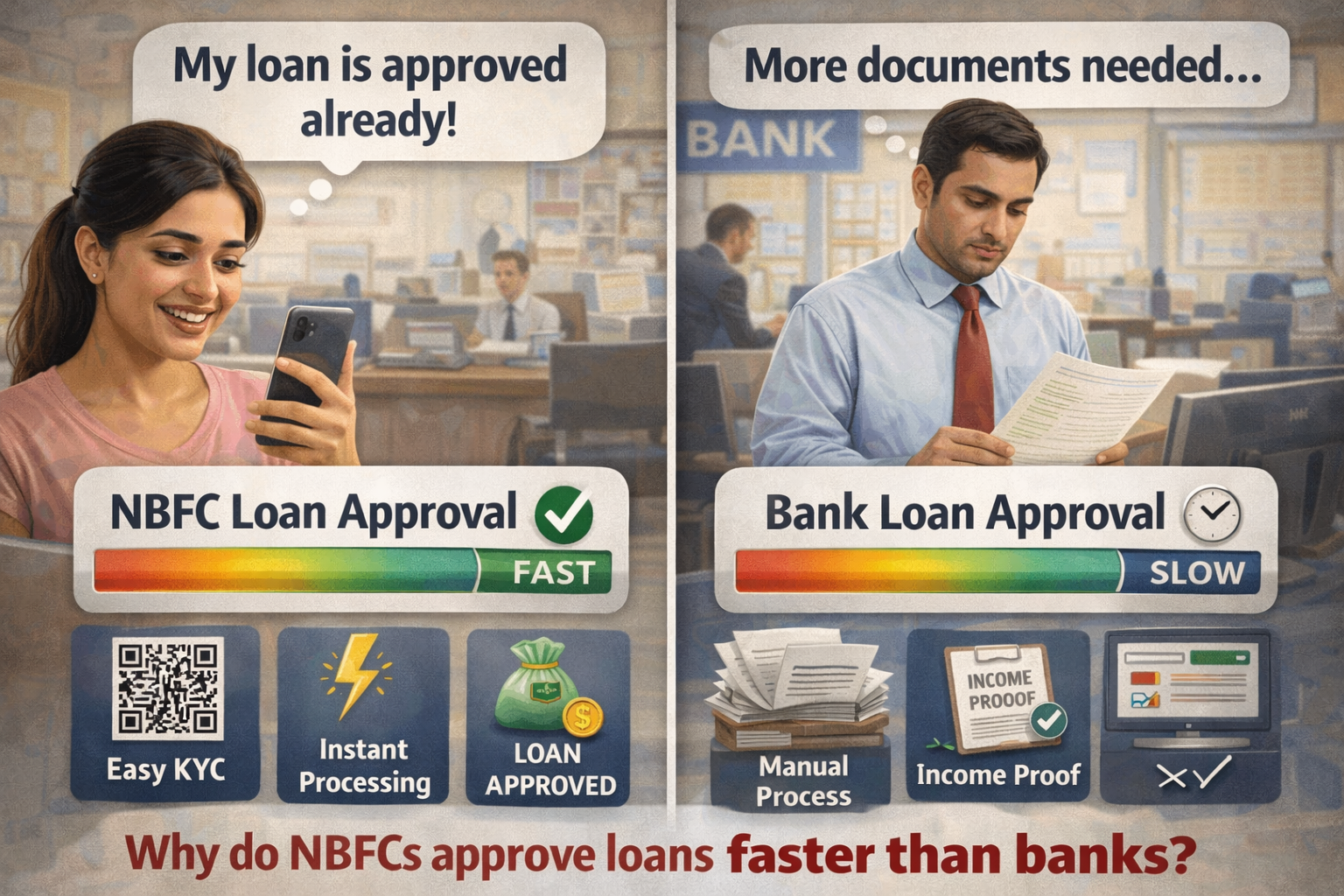
My neighbor Deepak needed ₹3 lakh urgently. His mother required surgery, and his insurance claim was stuck in processing.
He applied at his bank on a Monday morning. They asked for 15 different documents. Told him the approval would take 7-10 working days. Maybe longer if the credit committee had questions.
Frustrated, he tried an NBFC that same afternoon.
Approval came in 4 hours. Money in his account by next morning.
“Why didn’t I just go to them first?” he asked me later.
Good question. But here’s what he didn’t ask: “Why did they approve me so fast, and what am I actually paying for that speed?”
I’ve worked in banking for over 12 years, and I’ve seen both sides of this equation. Let me tell you exactly why NBFCs can move at lightning speed while banks crawl—and whether that speed is actually in your favor.
The Simple Answer (That Hides the Complicated Truth)
NBFCs approve loans faster because they’re built differently from banks.
Banks are like government offices—lots of rules, multiple approval layers, strict processes, heavy regulation.
NBFCs are like startups—lean structure, faster decisions, higher risk tolerance, profit-focused.
But that’s just scratching the surface. The real reasons go much deeper.
What Actually Makes NBFCs Different
1. They Have Fewer Regulatory Handcuffs
Banks in India operate under the Banking Regulation Act. They answer to the Reserve Bank of India for everything—every loan policy, every interest rate change, every process modification.
RBI watches banks like a hawk because banks hold public deposits. Your savings account, your fixed deposits—that’s money banks must protect with extreme caution.
NBFCs are also regulated by RBI, but less strictly. Why? Because most NBFCs don’t take deposits from the public (except some deposit-taking NBFCs which face tighter rules).
They get their lending money from:
- Banks (yes, banks lend to NBFCs)
- Mutual funds
- Insurance companies
- Foreign investors
- Bonds and commercial paper
No public deposits means less regulatory oversight. Less oversight means faster processes.
Think of it this way: Banks are driving with a strict instructor watching every move. NBFCs are driving alone—still need to follow traffic rules, but no one’s sitting next to them checking constantly.
2. Simpler Approval Structures
In a typical bank, your loan application goes through:
- Relationship manager (documents collection)
- Credit analyst (verification and assessment)
- Credit manager (review)
- Branch manager (recommendation)
- Regional credit committee (approval for larger amounts)
- Legal and technical verification teams
- Final disbursement team
Each layer takes time. Each person wants to protect themselves from future audits.
In an NBFC, especially smaller ones:
- Sales executive (documents)
- Credit assessment (often algorithm-based)
- One credit manager (approval)
- Disbursement
I’ve seen NBFC loan files with 3 signatures. Bank files? Sometimes 12-15 signatures across different departments.
Fewer people involved means faster decisions. It also means fewer checkpoints catching potential problems.
3. Technology-First Approach
Most NBFCs, especially the newer fintech ones, are built on technology from day one.
Banks? Many are running on software systems from the 1990s or early 2000s. They’ve added layers of new technology on top, but the core is often outdated.
I had a client who applied for a home loan at a public sector bank. The credit officer literally printed out his application, carried the physical file to another floor, got a signature, carried it back, scanned it, uploaded it to a different system, then emailed it to the next department.
At an NBFC, the entire workflow is digital. Application comes in online, algorithms assess it, approval notification is automatic, disbursement is a single button press.
One NBFC I know processes personal loan applications through an AI model that evaluates 100+ data points in under 60 seconds. The model gives a yes/no with a confidence score. A human reviews only the borderline cases.
At banks, every application gets human review. Humans are thorough. Humans are also slow.
4. Higher Risk Appetite
This is the big one that nobody emphasizes enough.
Banks are conservative by design and regulation. They’re expected to have very low default rates—typically under 3-4% for retail loans.
NBFCs can tolerate higher defaults—some run at 6-8% default rates and still remain profitable.
Why can they afford this? Because they charge much higher interest rates.
Let me break down the math:
Bank:
- Interest rate: 11% per year
- Default rate: 3%
- Net earnings after defaults: Still profitable at these rates
NBFC:
- Interest rate: 16-24% per year
- Default rate: 7%
- Net earnings after defaults: Higher profits despite more defaults
That higher interest rate cushion means NBFCs can say “yes” to riskier customers that banks would reject.
When you get approved in 4 hours, you’re not getting a better deal. You’re being charged extra for the risk you represent.
5. Desperate for Business Volume
Banks have hundreds of crores in deposits they need to lend out. But they also have stable customer bases and diversified income (fees, investment income, treasury operations).
NBFCs live and die by loan volume. If they’re not disbursing loans constantly, they’re not making money.
This creates urgency. They need to approve fast because the competition (other NBFCs and banks) might grab the customer while they’re still processing.
I’ve seen NBFC sales teams with daily disbursement targets. Not monthly—daily. That pressure creates speed, but it also creates corners being cut.
The Real Reasons Behind the Speed
Automated Credit Assessment Models
NBFCs rely heavily on algorithms to make lending decisions.
Your application feeds into a model that checks:
- Your credit score (yes, CIBIL score still matters)
- Your stated income
- Your employment type
- Your bank statement patterns (if you provide access)
- Your digital footprint (phone usage, app behavior, social media)
The algorithm spits out a number: 72% approval probability. If it’s above the threshold (say, 65%), auto-approved. Below that, rejected. In the middle? Human review.
This process takes minutes, not days.
Banks use models too, but they still require extensive human oversight and multiple verification layers. The models suggest, humans decide. At NBFCs, models often decide, humans just verify.
Minimal Physical Verification
Banks will send someone to verify:
- Your residential address
- Your office address
- Your property (for secured loans)
- Your references
This takes days, sometimes weeks if you live in a remote area or your office doesn’t cooperate quickly.
NBFCs increasingly skip this for smaller loans. They verify digitally:
- Video KYC (you show your face and documents on camera)
- GPS location tagging
- Digital rent agreements or utility bills
- LinkedIn profile for employment verification
For a ₹50,000-₹2 lakh personal loan, many NBFCs don’t do any physical verification at all. Everything is digital.
Faster? Absolutely. Riskier for them? Yes. But they’ve priced that risk into your interest rate.
Relationship With Employers and Aggregators
Many NBFCs have tie-ups with:
- Corporate HR departments
- Salary account platforms
- E-commerce companies
- Fintech apps
If you’re applying through your company’s payroll system or a partner app, the NBFC already has verified data about you. They don’t need to ask for salary slips—they’re pulling it directly from the source.
This pre-verified data makes approval near-instant.
Banks have some of these partnerships too, but NBFCs are far more aggressive about building them. Their entire business model depends on volume and speed.
Different Risk Philosophy
Banks think: “How can we be certain this person will repay?”
NBFCs think: “What’s the probability this person will repay, and can we profit even if some don’t?”
It’s a fundamental difference in approach.
Banks want certainty. They’ll reject 100 borderline cases to avoid 5 defaults.
NBFCs want volume. They’ll approve 100 borderline cases, accept that 8 might default, and still profit from the other 92 at high interest rates.
When your NBFC loan gets approved in hours, you’re in that 100. The algorithm calculated you’re probably good for repayment. Probably. Not certainly.
What Most People Don’t Realize About Fast Approvals
Speed Costs Money
That lightning-fast approval isn’t free. You’re paying for it through:
Higher interest rates: NBFCs typically charge 2-8% more than banks annually. On a ₹5 lakh loan over 3 years, that’s ₹30,000-₹1,20,000 extra in interest.
Processing fees: Banks charge 0.5-1% of loan amount. NBFCs often charge 2-5%. On ₹5 lakh, that’s ₹10,000-₹25,000 upfront.
Hidden charges: Prepayment penalties, documentation fees, late payment charges—NBFCs tend to have higher and more numerous fees.
I calculated once for a client: his ₹3 lakh NBFC loan approved in 6 hours cost him ₹47,000 more over 2 years than a bank loan would have. He paid ₹785 per hour for that “speed.”
Was it worth it? In his case yes, because he needed the money for a medical emergency. But most people don’t do this math.
Less Scrutiny Means Less Protection
Banks’ slow processes exist partly to protect borrowers from themselves.
The bank officer who questions whether you can really afford a ₹30,000 monthly EMI on your ₹60,000 salary? They’re annoying, but they’re also keeping you from financial disaster.
NBFCs are less likely to question your judgment. You want the loan, you meet their minimum criteria? Approved.
I’ve seen people take ₹5 lakh personal loans from NBFCs for expenses that definitely didn’t justify 18% interest rates—vacation, gadgets, wedding shopping for extended family.
The NBFC approved in one day. The person is still paying EMIs three years later for purchases they barely remember.
The Algorithm Doesn’t Know Your Whole Story
Automated approval sounds efficient, but algorithms can’t see context.
Your credit score dropped because you were hospitalized and missed one credit card payment. The algorithm just sees: missed payment, higher risk, higher interest rate or rejection.
A bank officer might see your explanation, review your overall profile, and make an exception.
The NBFC algorithm? It doesn’t care about your story. It just processes numbers.
This works in your favor when you look risky but aren’t. It works against you when you look okay but have legitimate circumstances that need human judgment.
The Connection to Your Overall Financial Health
Here’s something important about the bank loan approval process that people miss:
Banks reject faster approvals partly because they’re thinking long-term about you.
If they give you a loan you can’t afford, you default, your credit score crashes, and you become unable to borrow for years. They’ve created a problem for you and themselves.
NBFCs think shorter-term. Approve fast, collect payments, move to next customer. If you default, they’ve already made enough from you and others to cover the loss.
This is why the credit score vs loan eligibility equation is different at NBFCs. Banks might reject you at 690 score for your own good. NBFCs might approve you at 650 but charge you 22% interest.
One of the biggest CIBIL score myths is that lower approval standards are always good for borrowers. They’re not. Sometimes rejection is the better outcome.
I’ve seen people spiral into debt because an NBFC approved a loan a bank would have rejected. The loan was “easy to get” but impossible to repay comfortably.
Hidden Reasons Banks Reject Loans (That NBFCs Ignore)
Banks have strict internal policies about:
Job stability: Changed jobs twice in 18 months? Many banks auto-reject. NBFCs might not care if your current salary is good.
Debt-to-income ratio: Above 50%? Banks reject. NBFCs might approve at 60-65% if other factors look okay.
Industry risk: You work in a struggling sector? Banks flag it. NBFCs are less concerned if you’re currently employed.
Geographic risk: You live in an area with high historical defaults? Banks hesitate. NBFCs price the risk into your rate and approve anyway.
Age limits: Banks often reject 50+ applicants for long-tenure loans. NBFCs are more flexible.
Income documentation: Banks want three months of salary slips, six months of bank statements, ITR, Form 16. NBFCs might approve on just bank statement analysis.
These loan rejection reasons that banks enforce strictly become non-issues at NBFCs—because NBFCs have built business models that profit despite these risks.
When NBFC Speed Actually Makes Sense
Don’t get me wrong—NBFCs serve a real purpose. There are situations where their speed is worth the cost:
Genuine emergencies: Medical crisis, urgent family need, time-sensitive opportunity. When you need ₹2 lakh by tomorrow, paying extra 4% interest is worth it.
Business opportunities: You can buy inventory at 40% discount if you pay immediately. The NBFC loan at 16% for 6 months still leaves you profitable.
Bank rejection cases: You were rejected by banks for reasons that don’t reflect your actual repayment capacity. The NBFC gives you a chance.
Credit building: You have thin credit history. Taking a small NBFC loan, repaying perfectly, helps build your credit profile for future bank loans.
Short-term gaps: Your salary is delayed, rent is due. A 30-day NBFC loan, even at high interest, beats bouncing a cheque.
What doesn’t make sense: using NBFCs for non-urgent purchases just because approval is easy.
The Different Types of NBFCs (And Their Speed Variations)
Not all NBFCs are equal in speed:
Fintech NBFCs (fastest):
- Companies like PayTm, KreditBee, MoneyTap
- Fully digital, AI-driven
- Approval in minutes to hours
- Typically ₹10,000-₹5 lakh
- Interest rates: 14-36% depending on profile
Traditional NBFCs (medium speed):
- Bajaj Finserv, Tata Capital, Muthoot Fincorp
- Mix of digital and human assessment
- Approval in 1-3 days
- Higher loan amounts possible
- Interest rates: 11-20%
Vehicle and asset-focused NBFCs (slower):
- Mahindra Finance, Shriram Transport
- Need physical verification of assets
- Approval in 3-7 days
- Rates competitive with banks
- But still faster than bank equivalents
Gold loan NBFCs (fastest for secured):
- Muthoot, Manappuram
- You bring gold, they test it, instant approval
- Money in 30 minutes
- Interest rates: 10-18%
- But your gold is collateral
The speed correlates with risk level. Unsecured loans from fintech NBFCs are fastest because they’ve automated risk assessment. Secured loans are fast because they have collateral. Traditional NBFCs balance speed with verification.
What Banks Are Doing to Compete
Banks aren’t stupid. They see customers going to NBFCs for speed, and they’re adapting:
Pre-approved loans: Many banks now offer instant pre-approved personal loans to existing customers. You see the offer in your banking app, click accept, money arrives in hours.
Digital-only banks: Some banks have launched fully digital loan products with NBFC-like approval speeds.
Partnerships: Banks partnering with fintechs to offer faster approvals while keeping bank interest rates.
Algorithm adoption: Slowly, banks are implementing automated assessment for smaller loans.
But they’re still fundamentally slower because:
- Regulatory compliance takes time
- Multiple approval layers exist for accountability
- They’re protecting depositors’ money, so caution is built-in
- Legacy systems can’t be replaced overnight
The gap is narrowing, but NBFCs will likely always be faster for the reasons I’ve explained.
The Real Cost-Benefit Analysis
Let me show you actual numbers:
Scenario: You need ₹3 lakh urgently
Bank loan:
- Application to approval: 7 days
- Interest rate: 11% per year
- Processing fee: ₹3,000 (1%)
- Tenure: 3 years
- Total interest paid: ₹53,218
- Total cost: ₹3,53,218
NBFC loan:
- Application to approval: 1 day
- Interest rate: 17% per year
- Processing fee: ₹9,000 (3%)
- Tenure: 3 years
- Total interest paid: ₹85,932
- Total cost: ₹3,94,932
The difference: ₹41,714 extra for 6 days of speed.
That’s ₹6,952 per day you saved by going with the NBFC.
Now ask yourself: Is my need urgent enough to justify paying ₹6,952 per day?
Sometimes yes. Often no.
Red Flags to Watch for With NBFCs
Not all NBFCs are created equal. Some are well-regulated and trustworthy. Some are predatory.
Warning signs of problematic NBFCs:
Unrealistic approval promises: “100% approval guaranteed” is a lie. No legitimate lender approves everyone.
No RBI registration: Every NBFC must be RBI-registered. Check the RBI website before applying.
Upfront fees before approval: Legitimate NBFCs charge processing fees after approval, not before. Upfront fee demands are often scams.
Pressure tactics: “This rate is only available for next 2 hours” is manipulation. Take your time.
Unclear terms: If you can’t easily find the interest rate, all fees, and repayment terms in writing, walk away.
Access to your phone/contacts: Some predatory NBFCs ask for permissions to access your entire phone. Huge privacy red flag.
Third-party recovery agents: If they mention using “field agents” for collections, be very careful. Some use harassment tactics.
I’ve seen people get trapped by unlicensed or unethical NBFCs promising fast money. The approval was fast. The nightmare lasted months.
How to Use NBFCs Smartly
If you decide an NBFC loan makes sense:
1. Borrow the minimum needed: Don’t take ₹5 lakh just because you’re approved for it. Take exactly what you need.
2. Choose the shortest tenure you can afford: Every extra month costs you compounding interest. If you can manage ₹18,000 EMI instead of ₹15,000, choose the shorter tenure.
3. Prepay aggressively: Most NBFCs allow prepayment after 6-12 months. Save and prepay to cut interest costs.
4. Use it as a bridge: Take the NBFC loan for immediate need, then apply at a bank for a lower-rate loan to pay off the NBFC loan once you have time.
5. Read everything: Every word of the agreement. Look for hidden charges, prepayment penalties, late payment fees.
6. Set up auto-debit: Never miss an NBFC payment. Their late fees are brutal, and they report to credit bureaus faster than banks.
When to Definitely Choose Bank Over NBFC
Even if the bank is slower, choose them when:
The need isn’t urgent: If you’re planning a purchase next month, start the bank application now. No reason to pay extra for speed you don’t need.
Large loan amounts: For loans above ₹10 lakh, the interest rate difference becomes massive. Wait for bank approval.
Long tenures: For 5+ year loans, the compounding cost difference is substantial. Banks are worth the wait.
You have good credit: If your CIBIL score is 750+, banks will likely approve you. Use your good credit to get better rates.
Secured loans: For home loans, LAP (loan against property), or car loans, banks offer significantly better rates. The few extra days of processing are worth it.
You value customer service: Banks have branches everywhere. NBFCs, especially digital ones, offer limited physical support if issues arise.
Frequently Asked Questions
Q1: Are NBFC loans safe and legal?
Yes, if the NBFC is registered with RBI. Check the RBI’s list of registered NBFCs on their website before applying. Registered NBFCs follow regulations, report to credit bureaus, and have accountability. Unregistered entities are illegal and potentially dangerous. The loan itself is legal, but read all terms carefully—some NBFCs include clauses that heavily favor them.
Q2: Will taking an NBFC loan hurt my CIBIL score?
Not if you repay on time. NBFCs report to credit bureaus just like banks. A well-managed NBFC loan actually builds your credit history. However, defaults, late payments, or settling for less than full amount will hurt your score just as much as with bank loans—sometimes more, because NBFCs report quickly.
Q3: Can I get a bank loan to pay off my NBFC loan?
Yes, this is called loan refinancing or balance transfer. Once you’ve been paying the NBFC loan for 6-12 months on time, your credit score improves, and banks may offer you a lower-rate loan to pay off the expensive NBFC loan. You save on interest for the remaining tenure. Some banks specifically advertise balance transfer schemes.
Q4: Why do NBFCs ask for access to my phone and SMS?
They use this data for credit assessment—analyzing your financial app usage, transaction SMS, payment patterns, etc. It’s legal if you consent, but it’s also a privacy concern. Some NBFCs mandate it, others don’t. You can refuse and try NBFCs that don’t require this, though your approval odds might decrease if your other credentials are weak.
Q5: What happens if I default on an NBFC loan?
Same credit score damage as bank defaults—your score drops significantly, making future borrowing very difficult. NBFCs report to CIBIL, Experian, and other bureaus. However, some NBFCs use more aggressive recovery methods than banks—frequent calls, field agent visits, contacting your references. This is why it’s critical to borrow only what you can realistically repay.
Q6: Are NBFC personal loans better than credit card EMI?
Depends. Credit card EMIs often come at 12-18% interest (sometimes even 0% during promotional offers). NBFC personal loans are typically 14-24%. Compare the actual rates. However, credit cards have lower limits, so for larger amounts, NBFCs might be your only quick option. Also, credit card debt is revolving credit which impacts your CIBIL score differently than installment loans.
Q7: Can I negotiate interest rates with NBFCs?
Limited scope, but possible. Unlike banks, NBFC rates are often algorithm-determined based on your risk profile. However, if you have strong credentials or are borrowing a large amount, you can ask their sales team for rate negotiations. Existing customers with good repayment history have better leverage. It doesn’t hurt to ask—worst case, they say no.
Q8: Why do some NBFCs approve me when banks rejected me?
NBFCs have higher risk tolerance, less strict policies, and profit models that work even with higher default rates. What banks see as “too risky,” NBFCs see as “acceptable risk at 19% interest.” This doesn’t mean you’re a bad borrower—it often means banks are being overly cautious or you fell just below their strict cutoffs. But it also means the NBFC is charging you extra for that risk.
The Bottom Line
Why do NBFCs approve loans faster than banks?
Because they’re built for speed—fewer regulations, simpler structures, algorithm-driven decisions, higher risk tolerance, and a business model that profits from volume at higher rates.
Banks are built for stability—protecting deposits, minimizing defaults, heavy compliance, multiple verification layers, and conservative lending.
Neither is “better.” They serve different purposes.
NBFCs are like urgent care clinics—fast, accessible, more expensive, good for immediate needs.
Banks are like regular doctors—slower appointments, thorough examinations, better long-term care at lower cost.
Use NBFCs when speed genuinely matters and you’re willing to pay for it.
Use banks when you have time and want better terms.
Just don’t confuse fast approval with a good deal. Sometimes the loan that comes quickly is the one that haunts you longest.
The ₹3 lakh my neighbor got approved in 4 hours? It cost him ₹43,000 more than a bank loan would have over two years.
Was it worth it for his mother’s surgery? Absolutely.
Would it be worth it for a vacation or a new phone? Absolutely not.
Fast approval is a tool. Like any tool, it can help you or hurt you depending on how you use it.
Financial Disclaimer: This article provides general information based on the author’s experience in banking and financial services in India. NBFC policies, interest rates, and lending practices vary widely across institutions and change frequently. Bank procedures also vary by institution. This is not personalized financial advice. Always read loan agreements completely, compare multiple lenders, and verify current terms before borrowing. Consult a certified financial advisor for decisions specific to your situation.