
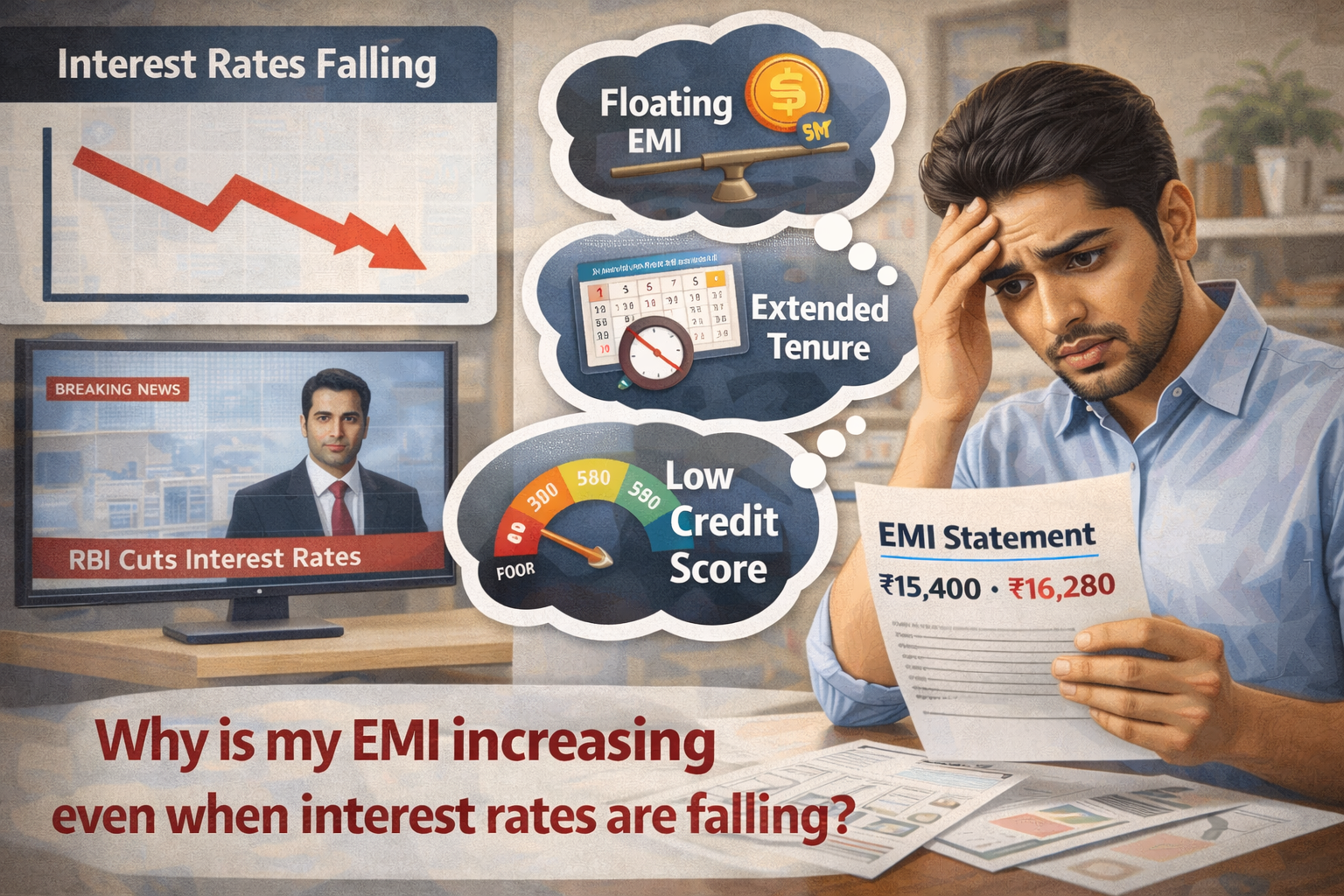
Last month, Prateek opened his bank statement and stared at it in disbelief.
His home loan EMI had increased by ₹2,847. Just like that. No warning, no explanation in the statement.
He’d been religiously following news about RBI reducing repo rates. He’d seen headlines saying “Home loan rates hit 5-year low.” He’d even calculated how much he’d save with lower rates.
And then his EMI went up instead of down.
“Is the bank cheating me?” he asked when he called me, furious.
I pulled up his loan documents. Within ten minutes, I found the issue. The bank wasn’t cheating him. But they also hadn’t explained how floating rate loans actually work—and how EMI calculations can produce results that seem completely backward.
I’ve spent over 12 years in banking and personal finance, and this question comes up constantly. People see falling interest rates and expect falling EMIs. When reality hits differently, they feel betrayed.
Let me explain exactly what’s happening with your loan—and why it’s often completely legal, even if it feels unfair.
The Short Answer (That Leads to More Questions)
Your EMI is increasing despite falling interest rates because of how your specific loan is structured.
The most common reasons:
- Your loan has a fixed EMI with variable tenure (not variable EMI)
- Your bank hasn’t actually reduced your loan rate yet
- You’re in the early years of the loan where interest forms the bulk of EMI
- Your loan was reset or restructured
- Additional charges or insurance got added
- Your bank reduced rates for new customers but not existing ones
But the real story is more complex and often more frustrating.
How Floating Rate Loans Actually Work (Not How Banks Explain Them)
When you took your home loan, car loan, or personal loan, the bank probably said: “This is a floating rate loan. When RBI reduces rates, your rate automatically comes down.”
Technically true. Practically misleading.
Here’s what they didn’t explain clearly:
The MCLR/Repo Link Disconnect
Your loan interest rate is linked to something called MCLR (Marginal Cost of Funds based Lending Rate) or the External Benchmark (like repo rate).
For MCLR-linked loans (most loans before 2019):
- Your rate resets only on your loan’s “reset date”—usually once a year
- Even when RBI cuts rates, your bank can take months to reduce MCLR
- Banks reduce MCLR slowly, in small steps, over time
- Your actual loan rate might not change for 6-12 months after RBI’s cut
For repo-linked loans (newer loans from 2019 onward):
- Rate changes happen faster—usually within one billing cycle
- But banks can still keep the “spread” (their profit margin) unchanged or even increase it
- So repo falls by 0.5% but your rate only falls by 0.25%
Prateek’s loan was MCLR-linked with an annual reset date of April 1st. RBI had cut rates in November. He was reading about falling rates, but his specific loan rate wouldn’t change until April—five months later.
In the meantime, something else in his loan structure had changed, causing the EMI to go up.
Fixed EMI vs. Fixed Tenure
This is where most confusion happens.
When you took the loan, the bank asked: “How do you want rate changes handled?”
Most people don’t even remember this conversation. The bank officer probably rushed through it. But your answer determines everything.
Option 1: Variable EMI, Fixed Tenure
- Tenure stays same (20 years stays 20 years)
- EMI changes when rates change
- Rate decreases → EMI decreases
- Rate increases → EMI increases
- Most straightforward option
Option 2: Fixed EMI, Variable Tenure
- EMI stays roughly the same
- Tenure changes when rates change
- Rate decreases → tenure reduces (you finish loan earlier)
- Rate increases → tenure increases (loan drags on longer)
- This is where EMI can actually go UP despite rate falling
How Option 2 causes rising EMI despite falling rates:
Let’s say your rate decreased from 8.5% to 8.0%. Good news, right?
The bank recalculates your loan. With the lower rate, you could finish your loan 14 months earlier at the same EMI.
But the bank’s system has limits. They won’t let tenure drop below certain minimums for administrative reasons. Or they’ve hit the maximum tenure extension already from previous rate hikes.
So they adjust the EMI slightly upward to keep tenure within acceptable bounds.
You get lower interest rates but higher EMI. Sounds impossible, but it happens.
I’ve seen this personally on dozens of loan statements. The math works out, but the optics are terrible.
Why Your Bank Hasn’t Reduced Your Rate Yet
RBI announces a repo rate cut. News headlines scream about it. You wait for your EMI to drop.
Nothing happens.
Why?
Banks Reduce Rates Slowly (By Design)
When RBI cuts repo rate by 0.5%, your bank doesn’t immediately cut lending rates by 0.5%.
Here’s the typical timeline:
Day 1: RBI announces cut Day 15-30: Banks announce deposit rate cuts (they move fast on this because it helps them) Day 30-60: Banks announce lending rate cuts, but smaller than RBI’s cut (maybe 0.25% vs RBI’s 0.5%) Day 60-90: Reduction reflects in MCLR charts Day 90-365: Your specific loan rate changes on your reset date
From RBI announcement to your actual EMI change: 3-12 months easily.
During this lag, if something else increases your EMI, you see a rising EMI in a falling rate environment.
The Spread Stays High
Your loan rate isn’t just MCLR or repo rate. It’s:
Your Rate = Benchmark Rate + Spread
Example: MCLR is 8.0% + Spread is 1.5% = Your rate is 9.5%
When benchmark rates fall:
- MCLR drops from 8.0% to 7.5%
- But your spread stays 1.5%
- Your new rate: 9.0%
You saved 0.5%. Good.
But here’s what banks do: They reduce MCLR for new customers more aggressively than for existing customers.
New customers get: 7.5% MCLR + 1.0% spread = 8.5% total
You get: 7.5% MCLR + 1.5% spread = 9.0% total
You’re still paying 0.5% more than new customers even though the “base rate fell.”
This is completely legal. Spreads are fixed at loan origination for most loans and don’t decrease automatically.
The Hidden Culprits Behind Rising EMIs
1. Insurance Premiums Got Added
Many home loans have insurance components:
- Property insurance (fire, earthquake)
- Life insurance (reducing balance term cover)
- Job loss protection insurance
These premiums can increase annually based on:
- Revised insurance rates
- Increasing property value
- Your advancing age (for life insurance)
The premium gets added to your EMI. Even if interest rates fall, the insurance bump can increase total EMI.
I had a client whose EMI increased by ₹340 despite rate reduction because her life insurance premium went up. She was 45 when she took the loan. Now at 52, the premium had increased significantly due to age-based recalculation.
2. Escrow Account Adjustments (For Home Loans)
Some banks bundle property tax and maintenance into your EMI in an “escrow account.”
Property taxes increase every year in most cities. When they do, your EMI increases to cover the higher escrow requirement.
Your interest rate fell, but your property tax went up more, so net EMI rose.
3. The Loan Was Restructured or Reset
During COVID-19, many people took moratoriums (payment holidays) or loan restructuring.
When loans get restructured:
- Outstanding principal gets recalculated
- Interest that should’ve been paid gets added to principal
- EMI gets recalculated based on new higher principal
- Even at lower rates, higher principal can mean higher EMI
Prateek had taken a 3-month moratorium in 2020. The interest for those months got added to principal. When his loan was recalculated in 2024, the base amount was higher than expected, pushing up the EMI despite rate reductions.
4. You Were on a Fixed Rate Period That Just Ended
Some loans offer:
- Fixed rate for first 2-3 years
- Floating rate after that
If your fixed rate period was 8% and it just ended, your loan converts to current floating rate of 9.5% (even if rates are generally “falling” from last year’s 10%).
You see an increase because you’re comparing to your old fixed rate, not to last year’s floating rate.
5. Partial Prepayments Weren’t Applied Correctly
You made a ₹2 lakh prepayment last year. The bank confirmed receipt.
But did they apply it correctly?
You have two choices with prepayments:
- Reduce EMI, keep tenure same
- Reduce tenure, keep EMI same
If you chose “reduce EMI” but the bank processed it as “reduce tenure,” your EMI stays the same while your tenure drops.
Then when rates change, the EMI recalculates from the wrong base, potentially increasing it.
I’ve seen this happen multiple times. Banks make processing errors. You need to verify prepayment application in writing.
6. Base Rate to MCLR Migration Issues
If your loan is very old (pre-2016), it might’ve been on “Base Rate” system.
When banks migrated loans from Base Rate to MCLR, some errors occurred:
- Wrong MCLR applied
- Spread miscalculated
- Reset dates changed without proper notification
These legacy issues can cause weird EMI behavior years later.
The Early Years Trap
Here’s something most people don’t understand about loan EMIs:
In the early years, your EMI is almost entirely interest. Principal repayment is tiny.
Example of a ₹50 lakh loan at 9% for 20 years:
- EMI: ₹44,986
- In Year 1, Month 1:
- Interest component: ₹37,500
- Principal component: ₹7,486
Look at that ratio. 83% interest, 17% principal.
Now rates fall to 8.5% and EMI recalculates to ₹43,391.
You save ₹1,595 per month. Feels great.
But then property insurance increases by ₹2,100 per month. Your net EMI is now ₹45,491—higher than before the rate cut.
The rate decrease was real. The EMI decrease was real. But other factors overwhelmed it.
In later years, when more of your EMI is principal, these additions matter less. But early in the loan, when you’re paying mostly interest, any additional charges can easily exceed rate reduction benefits.
What Your Bank Statement Doesn’t Tell You
When your EMI increases, your statement usually shows:
- New EMI amount
- Maybe a vague note: “EMI revised due to rate change”
What it doesn’t show:
- The specific components of the increase
- Why each component changed
- How much was rate-related vs. insurance vs. other charges
- What options you have
You have to call customer service, wait on hold for 20 minutes, and then the person reading from a script can’t explain it either.
This opacity is partly why people feel cheated. The math might be correct, but the communication is terrible.
How This Connects to Getting Future Loans
Here’s something important about the bank loan approval process that people miss:
How you manage your existing loans affects your ability to get new ones.
If you’re confused about why your EMI increased and you miss a payment while trying to figure it out, that missed payment hits your credit report.
One of the hidden reasons banks reject loans is seeing irregular EMI payments on your credit history—even if those irregularities came from you being confused about changing EMIs.
This ties into the credit score vs loan eligibility equation. Your CIBIL score might be 760, but if your credit report shows you missed two EMI payments (even if you eventually paid), banks get nervous during the loan approval process.
One of the biggest CIBIL score myths is that your score tells the whole story. It doesn’t. Banks look at payment patterns too.
So understanding your EMI changes isn’t just about current frustration—it affects your future borrowing ability.
What You Should Do Right Now
Step 1: Get Your Loan Statement Details
Call your bank and ask for:
- Current loan outstanding (principal remaining)
- Current interest rate
- Current EMI breakdown (principal vs. interest vs. insurance vs. other)
- Reset date for your loan
- Previous EMI amount and components
- Reason for EMI change
Don’t accept vague answers. Ask them to email you the details in writing.
Step 2: Calculate What Your EMI Should Be
Use an online EMI calculator. Input:
- Remaining principal
- Current interest rate
- Remaining tenure
Compare the calculated EMI with what you’re actually paying.
If there’s a big difference, something else is included in your EMI.
Step 3: Check for Added Components
Look for:
- Insurance premiums (property, life, job loss)
- Processing fees being recovered
- Late payment charges from previous months
- Tax escrow adjustments
- Legal or technical verification charges
These can add ₹500-₹3,000 to your EMI without being “interest rate related.”
Step 4: Verify Your Loan Type
Check your loan agreement:
- Is it fixed EMI or variable EMI?
- What’s the reset frequency (monthly, quarterly, annual)?
- Is it MCLR-linked or repo-linked?
- When was your last reset date?
This determines when you should actually see rate changes reflected.
Step 5: Compare Against Current Market Rates
Look up:
- Current MCLR for your bank
- Current rates for new customers
- Rates at other banks
If you’re paying significantly more than new customers or other banks, you have leverage to negotiate or refinance.
Step 6: Raise a Formal Complaint if Needed
If the bank can’t explain the increase satisfactorily or if you suspect an error:
- Raise complaint with branch manager (in writing)
- If no response in 30 days, escalate to bank’s grievance cell
- If still unresolved, approach Banking Ombudsman
- Keep all documentation—loan agreement, statements, email correspondence
I’ve seen errors corrected after formal complaints where customer service phone calls went nowhere.
When Rate Cuts Don’t Benefit You (And Why)
Sometimes, falling rates genuinely don’t help existing borrowers:
Your Loan Has a Floor Rate Clause
Some loan agreements have a clause: “Interest rate will not fall below X%”
Even if MCLR drops below that floor, your rate stays at the floor.
This is more common in loans taken during low-rate periods. The bank protected themselves against rates falling further.
Check your loan agreement for “minimum rate” or “floor rate” clauses.
You’re on Fixed Rate
Fixed rate means fixed. Doesn’t matter if market rates fall to zero—your rate stays locked until the fixed period ends.
Some people deliberately chose fixed rates for stability. Others didn’t realize what they were signing up for.
The Spread Absorbs the Benefit
Your MCLR dropped 0.5%. But in the fine print, the bank reserved the right to “adjust spread based on risk assessment.”
They increased your spread by 0.4%. Net benefit to you: 0.1%.
This is rare but legal if mentioned in loan terms.
Administrative Lag
Your rate will fall, but only on the next reset date which is 8 months away.
Meanwhile, insurance went up last month.
Timing mismatch makes it look like rates falling didn’t help you.
How to Actually Benefit From Falling Rates
Switch to Variable EMI Structure
If you’re on fixed EMI structure and rates are falling, ask the bank to switch you to variable EMI.
They usually allow this once during the loan tenure.
With variable EMI:
- Rate decreases immediately reduce your EMI
- You see the benefit faster
- Your tenure stays predictable
Negotiate Your Spread
If you’re paying 1.5% spread and new customers get 1.0%, call the bank.
Especially if:
- You’ve been a customer for years
- You’ve never missed a payment
- Your credit score has improved since you took the loan
- You have other accounts/relationships with the bank
Tell them: “I’ll refinance with another bank if you don’t match current rates.”
Sometimes they’ll reduce your spread. Not always, but worth trying.
Refinance to Another Bank
If your current bank won’t budge and you’re paying significantly higher rates:
When refinancing makes sense:
- Rate difference is 1% or more
- You have 10+ years remaining on the loan
- You won’t incur heavy prepayment penalties
- Your credit profile has improved
When it doesn’t:
- Less than 5 years remaining (not enough time to recover refinancing costs)
- Heavy prepayment penalties
- Processing fees too high
- Your credit score has dropped since original loan
Run the numbers. Include all costs. Then decide.
Make Strategic Prepayments
When rates fall and your EMI decreases, don’t spend the saved amount.
Prepay with it.
Example:
- Old EMI: ₹45,000
- New EMI after rate cut: ₹42,000
- Saved: ₹3,000/month
Prepay ₹3,000 extra every month. You won’t feel the difference (you were already paying ₹45,000), but you’ll finish your loan years earlier and save lakhs in interest.
This is the smartest way to benefit from rate cuts.
Common Mistakes People Make
Mistake 1: Assuming Rate Cuts Are Immediate
They’re not. Reset dates, MCLR cycles, and administrative processes mean delays of months.
Expecting instant EMI drops leads to disappointment and confusion.
Mistake 2: Not Reading Loan Statements
Most people glance at EMI amount and ignore the details.
Read the full statement. Look at the breakup. Compare month-over-month.
Early detection of errors or unexplained increases prevents bigger problems later.
Mistake 3: Arguing With Customer Service Without Data
Calling the bank and shouting “Why did my EMI go up?” without knowing your loan terms gets you nowhere.
Arm yourself with data first. Know your numbers. Then call.
Mistake 4: Missing EMI Payments While Disputing
Even if you think the increase is wrong, pay the EMI.
Missing payments damages your credit score. Dispute simultaneously, but keep paying.
If you win the dispute, you’ll get a refund. If you miss payments, the damage is permanent.
Mistake 5: Not Leveraging Competition
Banks compete for customers. Use that.
“HDFC is offering me 8.5% to refinance. Can you match it?”
Works more often than people think.
Special Situations That Cause Confusion
Joint Loan Where One Person Is NRI Now
If your joint home loan includes someone who’s now an NRI (Non-Resident Indian), some banks treat the entire loan under NRI norms, which often have higher rates.
Rate cuts might not apply or apply differently.
Loan Transferred Due to Bank Merger
Your bank merged with another. Your loan got transferred.
The new bank’s policies might be different. Reset dates might have changed. Spreads might have been recalculated.
This creates a mess. Always verify loan terms after a merger.
Loan Was Topped Up
You took a top-up loan (additional borrowing on existing loan).
The new amount might be at current higher rates even if your original loan is at lower rates.
Your EMI now includes both portions, creating a blended rate that doesn’t match either the old or new rates exactly.
Moratorium Interest Capitalization
You took moratorium during COVID or other hardship.
That interest got added to principal. When EMI recalculated post-moratorium, the base amount was higher.
Even at lower rates, higher principal equals higher EMI.
How Banks Could Communicate Better (But Don’t)
Imagine if your bank statement showed:
Previous EMI: ₹44,500
Changes this month:
- Interest rate decreased 0.25%: -₹750
- Property insurance annual increase: +₹150
- Life insurance age adjustment: +₹180
- Tenure adjustment to stay within limits: +₹600
New EMI: ₹44,680
Clear, transparent, understandable.
Instead, you get: “EMI revised. New amount: ₹44,680.”
Banks don’t provide this transparency because:
- Legacy systems can’t generate such detailed breakdowns easily
- They don’t want customers questioning every component
- Customer service can’t handle the volume of queries detailed statements would generate
- Opacity favors the bank in many cases
But it creates mistrust and frustration.
Frequently Asked Questions
Q1: Can my bank increase EMI without informing me?
Legally, they should inform you before EMI changes, but practically, many banks notify poorly—a small note in statement or SMS you might miss. For rate-linked changes, they often consider your loan agreement’s floating rate clause as sufficient “permission.” For non-rate changes (insurance, fees), they should inform clearly but often don’t. Always check your loan agreement for notification terms.
Q2: What if I can’t afford the increased EMI?
Contact your bank immediately—before missing any payment. Options include: extending tenure to reduce EMI, loan restructuring, payment holiday (adds interest but gives breathing room), or refinancing to another lender. Never just stop paying. One missed EMI reports to credit bureaus and damages your score, affecting future borrowing ability.
Q3: How often can my EMI change?
Depends on your loan type. Repo-linked loans can change quarterly or even monthly when RBI adjusts rates. MCLR-linked loans typically change annually on your reset date. Fixed-rate loans don’t change during the fixed period. Check your loan agreement for “reset frequency” or “rate revision cycle” to know your specific schedule.
Q4: Is it worth switching from MCLR to repo-linked loan?
Some banks allow this conversion. Worth it if: (a) you have 10+ years remaining, (b) bank charges minimal conversion fees, and (c) you believe repo rates will fall in coming years. Repo-linked loans respond faster to rate cuts but also to rate increases. Run projections for both scenarios before switching. Not all banks allow this conversion.
Q5: Can I refuse to pay the increased EMI?
No. Your loan agreement allows the bank to revise EMI based on rate changes and other agreed factors. Refusing to pay means defaulting, which damages your credit score and can lead to legal action for secured loans (property seizure for home loans). Your option is to dispute and seek correction if there’s an error, but keep paying meanwhile.
Q6: How do I know if my bank made a calculation error?
Download an EMI calculator app or use online calculators. Input your exact remaining principal, current interest rate, and remaining months. The calculated EMI should closely match your actual EMI (within ₹100-200 for small differences in methodology). If there’s a gap of ₹1,000+, something else is included or there’s an error. Request detailed breakup from bank.
Q7: Will making prepayments affect how rate changes impact my EMI?
Yes. Prepayments reduce principal, which changes the calculation base. If you chose “reduce EMI” during prepayment, your new EMI is lower and subsequent rate changes apply to this lower base. If you chose “reduce tenure,” EMI stays same but you finish earlier. Always specify your preference during prepayment—banks default to what benefits them more.
Q8: Why do new customers get better rates than me?
Banks compete for new business and offer promotional rates to attract customers. Existing customers have switching costs (refinancing hassle, fees, paperwork), so banks exploit this “stickiness.” Your spread was set when you took the loan and typically doesn’t change. This is legal but frustrating. Your leverage: threaten to refinance elsewhere. Sometimes they’ll match new customer rates to retain you.
The Bottom Line
Why is your EMI increasing even when interest rates are falling?
Because loan EMIs are complex calculations involving multiple factors beyond just the base interest rate.
Rate changes take time to reflect. Loan structures (fixed vs. variable EMI) affect how changes show up. Insurance, taxes, and other components can increase. Banks move slowly on cutting rates but quickly on other adjustments. Timing mismatches create confusing scenarios.
The frustrating part? Banks explain this poorly at loan origination and worse when changes happen.
The empowering part? Once you understand the mechanics, you can:
- Verify your EMI calculations
- Catch errors
- Negotiate better terms
- Make informed decisions about refinancing or prepayments
- Plan your finances accurately
Don’t assume the bank is cheating you, but also don’t assume they’re transparent.
Get your loan details. Understand your specific terms. Run the numbers yourself.
When Prateek finally got his detailed statement after three calls and one written complaint, here’s what he found:
- Interest rate had dropped 0.15% (saving ₹680/month)
- Property insurance increased ₹420/month
- Life insurance age adjustment added ₹340/month
- His fixed-EMI structure required tenure adjustment, adding ₹2,087/month to keep tenure within bank’s 25-year maximum
Total increase: ₹2,847
The rate did fall. His EMI still went up.
Once he understood this, he switched to variable EMI structure and made a ₹3 lakh prepayment. His new EMI dropped to ₹1,200 below where it started.
But it took him understanding the system first.
That’s the real lesson: Banks control the game, but you can learn the rules.
Financial Disclaimer: This article provides general information based on the author’s experience in banking and personal finance in India. Loan terms, EMI calculation methods, and bank policies vary widely across lenders and loan types. Interest rate structures and reset mechanisms differ by institution. This is not personalized financial or legal advice. Always read your specific loan agreement, verify calculations with your lender, and consult a certified financial advisor for decisions affecting your loans. Numbers used in examples are illustrative and may not match your specific situation.