
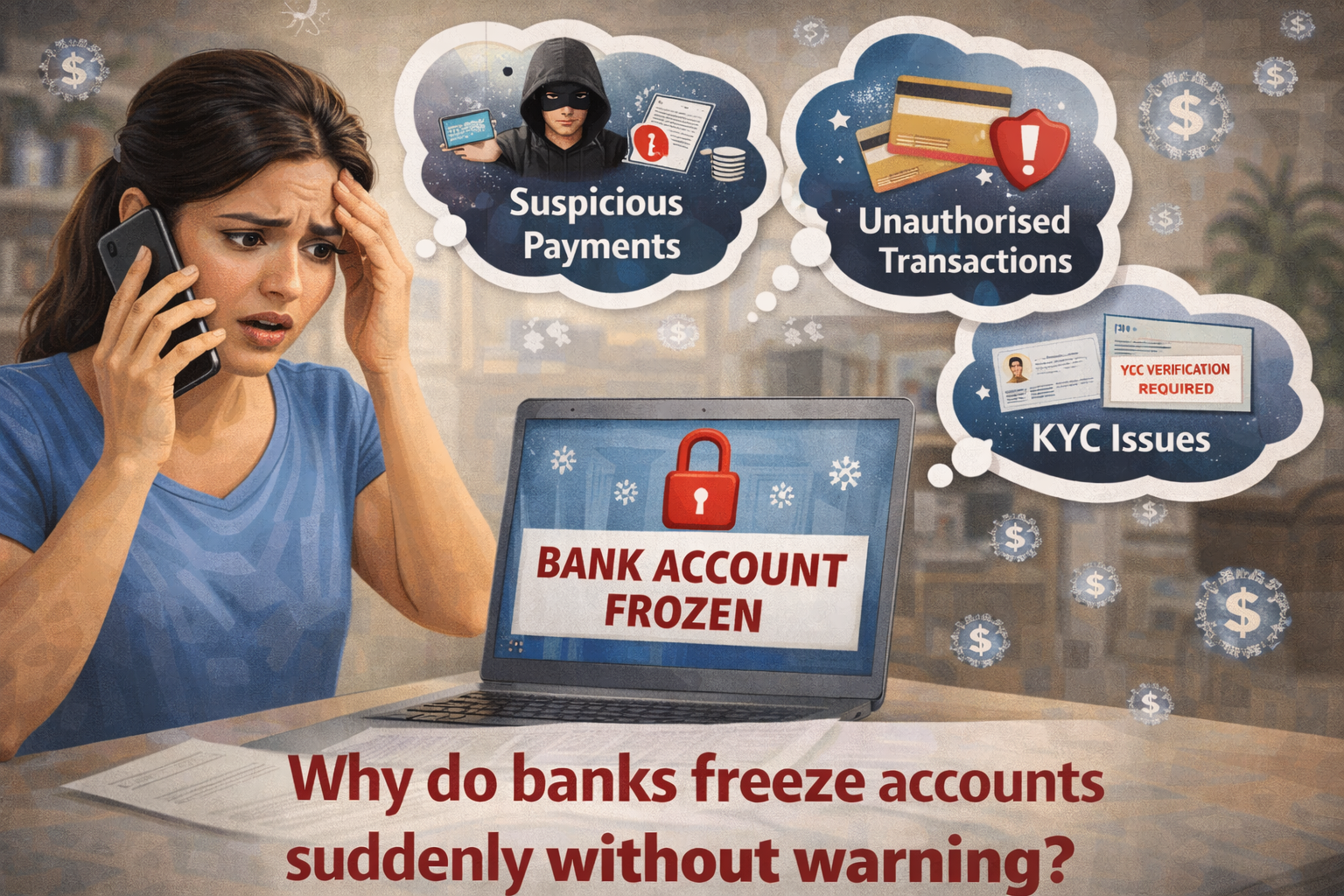
At 11:30 PM on a Tuesday, Meera tried to order dinner through Swiggy. Payment declined.
She tried her debit card. Declined.
She logged into net banking to check her balance. The screen showed: “Account temporarily restricted. Contact your branch.”
Her heart sank. She had ₹4.2 lakh in that account. Her rent was due in two days. Her daughter’s school fees auto-debit was scheduled for Friday.
Everything was frozen. No warning. No email. No SMS. Nothing.
She called the customer care number. After 20 minutes on hold: “Ma’am, we cannot discuss this over phone. Please visit your branch tomorrow.”
Tomorrow? She needed access to her money NOW.
I’ve worked in banking for over 12 years, and I’ve seen this scenario play out hundreds of times. The panic. The confusion. The feeling of helplessness when you can’t access your own money.
Let me tell you exactly why banks freeze accounts, what triggers these freezes, and most importantly—what you can actually do about it.
The Uncomfortable Truth About Your Bank Account
Here’s something most people don’t realize: the money in your bank account isn’t exactly “yours” in the way cash in your hand is yours.
Legally, when you deposit money in a bank, you’re lending it to the bank. They owe it back to you on demand, but they also have the right—sometimes the legal obligation—to freeze access under certain circumstances.
Your account can be frozen for reasons that have nothing to do with you personally. Or for reasons you don’t even know exist.
And here’s the part that makes people furious: banks often freeze first and explain later.
Why? Because in many cases, advance warning would defeat the purpose of the freeze.
The Most Common Reasons for Sudden Account Freezes
1. Automated Fraud Detection Systems Gone Wrong
This is the number one reason for sudden freezes, and it catches innocent people constantly.
Banks use sophisticated algorithms that monitor every transaction in real-time looking for “suspicious patterns.”
What triggers these algorithms?
Unusual transaction amounts:
- You normally spend ₹5,000-₹15,000 monthly
- Suddenly you make a ₹2 lakh payment
- System flags it as potential fraud
Geographic anomalies:
- You’re in Mumbai
- Someone uses your card in Delhi
- Both transactions within 2 hours
- Physically impossible, must be fraud (or so the system thinks)
Multiple failed PIN attempts:
- You forgot your PIN, tried 3 times incorrectly
- System assumes card is stolen
- Automatic freeze
Rapid-fire transactions:
- You make 10 UPI payments in 15 minutes
- System thinks your account is compromised
- Freeze triggered
Late-night activity:
- You make a large transfer at 2 AM
- Your account never shows activity at that hour
- Algorithm gets suspicious
I had a client whose account was frozen because he bought a ₹85,000 laptop while on a work trip to Bangalore. He lived in Pune, his card was never used outside Pune before, and the amount was 10x his normal transaction size.
Three red flags. Instant freeze.
The purchase was legitimate. The freeze was automatic. The inconvenience was massive.
2. Regulatory Compliance and KYC Issues
Banks operate under strict Know Your Customer (KYC) regulations. If your KYC details are incomplete, outdated, or don’t match across databases, they can freeze your account.
Common KYC triggers:
Address mismatch:
- Your Aadhaar shows one address
- Your PAN shows another
- Bank records show a third
- System flags inconsistency
Expired documents:
- Your passport that you gave for KYC expired
- Bank’s periodic verification caught it
- Account frozen until you update
Pending KYC updates:
- RBI mandated biometric verification by a certain date
- You didn’t complete it
- Automatic freeze on that date
Name variations:
- Aadhaar says “Rajesh Kumar Sharma”
- PAN says “R K Sharma”
- Bank account says “Rajesh Sharma”
- System sees three different people
Meera’s freeze? Her PAN card had her maiden name. Her Aadhaar had her married name. The bank’s periodic KYC check flagged the mismatch.
No fraud. No suspicious activity. Just documentation mismatch.
But frozen nonetheless.
3. Tax Department Attachment Orders
The Income Tax Department can instruct banks to freeze accounts if they believe you owe taxes.
This happens when:
- You have pending tax demands that are unpaid
- You haven’t responded to tax notices
- There’s an ongoing tax investigation
- You’re under scrutiny for unreported income
The scary part? The bank must comply immediately. They literally have no choice.
You find out about the tax issue when you discover your account is frozen. The tax department doesn’t warn you first—that would give you time to move money.
I’ve seen accounts frozen for tax demands as small as ₹47,000 that the person genuinely didn’t know existed because the notice went to an old address.
4. Court Orders and Legal Attachments
If someone files a case against you and obtains a court order, the court can direct the bank to freeze your account.
This happens in:
- Divorce proceedings (preventing asset dissipation)
- Business disputes
- Loan default cases
- Cheque bounce proceedings
- Property disputes
You might not even know the case was filed. The court order goes to the bank, not to you first.
The bank receives the order and complies. Your account freezes. You discover it when your card gets declined.
5. Suspected Money Laundering Activity
Banks are legally required to report “suspicious transactions” to the Financial Intelligence Unit (FIU) under anti-money laundering laws.
What looks suspicious?
Structuring transactions:
- Multiple deposits just under ₹50,000 (the reporting threshold)
- Looks like you’re trying to avoid detection
- Triggers investigation
Unusual cash deposits:
- You’re a salaried person
- Suddenly depositing ₹2 lakh cash monthly
- No clear source explanation
Round-robin transfers:
- Money comes in from Person A
- Immediately goes out to Person B
- Your account is just a conduit
- Looks like layering (money laundering technique)
High-value transactions inconsistent with profile:
- You’re a student
- Suddenly receiving ₹15 lakh transfers
- No apparent legitimate reason
The bank doesn’t need to prove you’re actually laundering money. They just need to suspect it. And they’ll freeze while they investigate.
6. Dormant Account Reactivation Issues
If your account was inactive for 2+ years, it’s classified as “dormant.”
When you suddenly try to use it, the bank’s systems might:
- Flag it for verification before allowing transactions
- Require in-person branch visit to reactivate
- Temporarily freeze until identity is re-verified
This protects against someone accessing an old account you’d forgotten about.
But if you actually just hadn’t used it and suddenly need it, you’re locked out.
7. Fraud Claims From Other Parties
Someone claims they sent you money by mistake and it’s fraud. Or someone reports unauthorized transactions that eventually trace to your account.
The bank freezes your account while investigating—even if you’re an innocent intermediary who had no idea.
Common scenario:
- Someone’s account gets hacked
- Hacker transfers money to multiple accounts including yours (maybe you sold something online and this was “payment”)
- Original account holder reports fraud
- Bank traces transactions and freezes all recipient accounts
You did nothing wrong. You received legitimate payment for a service. But your account is frozen while the bank unravels the fraud chain.
8. Exceeding Transaction Limits
Some accounts have daily/monthly transaction limits. Exceed them and the account can auto-freeze as a security measure.
Common limits people forget about:
- Basic savings accounts: ₹50,000 monthly withdrawal limit
- UPI: ₹1 lakh per day across all apps
- Net banking transfers: varies by account type
- ATM withdrawals: typically ₹25,000-₹50,000 per day
Hit these limits and your account or payment channel freezes temporarily—usually until the next day or month.
9. Deceased Account Holder Issues (Joint Accounts)
If you have a joint account and the primary holder passes away, banks often freeze the account until legal succession is established.
Even if it’s a joint account where either person can operate it, banks become cautious after death to avoid legal complications with the deceased’s estate.
10. Regulatory Directives for Specific Cases
Sometimes regulatory bodies (RBI, SEBI, SFIO) issue directives to freeze certain accounts as part of larger investigations.
You might be tangentially connected to something you’re not even aware of:
- Your employer is under investigation
- You received payments from a company now being investigated
- Your account was used in a transaction chain being examined
Your account gets frozen as part of a broader net.
Why Banks Don’t Warn You First
This is what makes people angriest: the lack of warning.
Banks have reasons (not all of them good):
Legal Requirements
For fraud investigations and legal orders, warning you first is literally illegal. The entire point is to preserve evidence and prevent you from moving assets.
Automated Systems
Many freezes are triggered by algorithms. The system doesn’t “decide” to warn you—it just executes the freeze based on programmed rules.
By the time a human reviews it, your account is already frozen.
Risk of Escalation
If the bank suspects fraud, telling you first gives the fraudster (if it is fraud) time to extract more money or cover tracks.
Regulatory Penalties
If the bank fails to freeze when they should have and something goes wrong, they face massive penalties from RBI.
So they err on the side of freezing too much rather than too little.
Poor Communication Systems
Honestly? Many banks just have terrible communication infrastructure.
The system that freezes accounts doesn’t automatically trigger the system that sends SMS alerts. Someone has to manually initiate customer communication, and that’s low priority during a freeze investigation.
What Actually Happens When Your Account Is Frozen
Understanding the process helps you respond better:
Within seconds:
- Automated system or manual order triggers the freeze
- All debit transactions stop immediately
- Cards decline
- UPI fails
- Net banking shows restriction message
- Cheques bounce
Credits still work:
- People can still send you money
- Salary deposits continue
- But you can’t withdraw or spend
Bank’s internal process:
- Case gets assigned to compliance or fraud team
- Investigation begins
- Documents are reviewed
- External verification if needed (tax dept, court, police)
Timeline varies wildly:
- Automated fraud freeze: Resolved in 24-48 hours if legitimate
- KYC issues: 3-7 days to update and verify
- Tax/legal orders: Weeks to months until underlying issue is resolved
- Investigation cases: Could be 30-90 days
During this time, you’re stuck.
The Connection to Your Credit Score and Future Loans
Here’s something crucial that people don’t realize: account freezes can indirectly affect your loan eligibility.
If your account is frozen and you have:
- Auto-debit EMIs that bounce
- Credit card payment auto-debit that fails
- Standing instructions that can’t execute
These failed payments report to credit bureaus.
Your CIBIL score drops. Your credit history shows missed payments.
Even though it wasn’t your fault—your account was frozen—the credit report doesn’t show context. It just shows: payment missed.
This becomes one of the hidden reasons banks reject loans later. During the bank loan approval process, they see irregular payment history and get nervous.
One of the biggest CIBIL score myths is that your score only reflects intentional defaults. It doesn’t. Technical defaults from frozen accounts count too.
The relationship between credit score vs loan eligibility includes your payment consistency. A frozen account that causes payment bounces directly harms this.
I’ve seen people with 750+ scores get rejected because their credit report showed 3 missed EMI payments—all from a 15-day account freeze they couldn’t control.
What to Do the Moment You Discover Your Account Is Frozen
Immediate Actions (First 2 Hours)
1. Confirm it’s actually frozen
Try multiple channels:
- ATM withdrawal
- UPI payment
- Net banking transfer
- Debit card swipe
If all fail with similar error messages, it’s a freeze.
2. Check for communication
Look through:
- Email (including spam folder)
- SMS
- Physical mail from bank
- Bank app notifications
Sometimes there IS communication, you just missed it.
3. Call customer care immediately
Yes, they might not resolve it, but you need to:
- Get it officially logged
- Get a complaint/ticket number
- Ask for the specific reason (they may or may not tell you)
- Ask for the department handling it
- Request a timeline for resolution
4. Visit the branch first thing next morning
Bring:
- Original ID proofs (Aadhaar, PAN, passport)
- Bank statements
- Any legal documents if you know the reason
- Your complaint number from customer care
Branch managers often have more authority to expedite than phone support.
Document Everything
From this moment, create a paper trail:
- Screenshot all error messages
- Save all email/SMS communication
- Note down names of every bank employee you speak with
- Keep copies of everything you submit
- Get written acknowledgment of your complaint
If this goes wrong, you’ll need this documentation.
Arrange Emergency Funds
While fighting the freeze:
Immediate options:
- Use credit cards if you have them
- Borrow from family/friends
- Use other bank accounts if you have them
- Cash any physical cheques elsewhere
Protect critical payments:
- Call your landlord, explain the situation, ask for a few days
- Call loan companies, request short extension
- Contact utility companies before they cut service
- Use credit card to pay critical bills if possible
Don’t let the freeze cascade into other crises.
Escalate Systematically
If branch doesn’t resolve in 24-48 hours:
Day 3-4: Escalate within bank
- Contact regional manager
- Email grievance cell
- Use bank’s official complaint portal
Day 7-10: External escalation
- File complaint with Banking Ombudsman
- Tweet at bank’s official handle (public pressure works)
- Contact RBI’s consumer helpline
Day 15+: Legal options
- Send legal notice through lawyer
- File case in consumer court
- Claim damages for harassment and losses
Most freezes resolve before you need legal action, but know your options.
How to Prevent Account Freezes
You can’t prevent all freezes, but you can reduce the risk:
Maintain Clean KYC
Do this annually:
- Verify all documents are current
- Ensure name matches exactly across all IDs
- Update address if you’ve moved
- Complete any pending verification requests
Use bank’s self-service KYC:
- Many banks have apps for KYC updates
- Upload documents proactively
- Don’t wait for the bank to ask
Maintain Transaction Patterns
Inform bank before unusual activity:
- Planning to make a large purchase? Call the bank first
- Traveling abroad? Notify the bank
- Expecting large incoming transfer? Give them heads up
Keep activity regular:
- Don’t let accounts go completely dormant
- Make at least one transaction monthly
- Use net banking occasionally so it doesn’t look suspicious when you need it
Stay on Top of Legal and Tax Issues
Monitor tax notices:
- Check your registered email with tax department
- Use income tax portal regularly
- Respond promptly to any queries
Know your legal status:
- If you’re in any dispute, be aware courts could issue orders
- Keep documentation proving your side
- Don’t ignore legal notices
Keep Multiple Banking Relationships
Never keep ALL your money in one account. Diversification protects you:
Recommended structure:
- Primary salary account with 2-3 months expenses
- Secondary account at different bank with emergency buffer
- One account with minimal balance just as backup
If one freezes, you’re not completely stuck.
I’ve written extensively about this before, but it bears repeating: keeping all your savings in one bank account is risky precisely because of freezes.
Monitor Your Account Regularly
Check your account weekly:
- Look for unauthorized transactions
- Verify all debits match your records
- Ensure credits are as expected
- Watch for suspicious patterns
Early detection of actual fraud prevents freezes. If something is wrong and you catch it first and report it, you control the narrative.
Respond to Bank Communication Promptly
When the bank sends:
- KYC update requests
- Document verification emails
- Security alerts
- Transaction confirmations
Respond immediately. Don’t procrastinate.
Most preventable freezes happen because people ignore these communications until it’s too late.
Special Cases and Hidden Triggers
NRI Account Complications
If you’re an NRI (Non-Resident Indian) or became one:
Your resident account should convert to NRO/NRE account. If it doesn’t, the mismatch can trigger freeze when the bank’s periodic verification discovers you’re abroad.
Always inform the bank when your residential status changes.
Business Transactions in Personal Accounts
Using personal account for business transactions is risky:
Banks don’t like it because:
- Personal accounts have lower monitoring thresholds
- Business volumes look suspicious in personal accounts
- Tax implications aren’t clear
- It violates account terms of service
Large, frequent business transactions in personal savings account can trigger money laundering flags.
Get a current account if you’re running a business.
Cryptocurrency Transactions
Many Indian banks have internal policies against crypto:
If you’re receiving money from crypto exchanges or sending money to them:
- Some banks auto-flag these transactions
- Account can be frozen pending investigation
- Bank may ask you to close account entirely
This is a grey area legally, but banks exercise extreme caution.
Political Exposure
If you become “politically exposed” (elected to office, government position, etc.), banks are required to apply enhanced due diligence.
Your existing account might undergo review, and any unusual activity will be scrutinized heavily.
Inform the bank when your status changes to avoid freezes.
What Banks Won’t Tell You
Having worked inside banks, here are insider realities:
Freezes Are Often Overly Cautious
Banks know they freeze innocent accounts. They accept this as collateral damage.
Why? Because the cost of NOT freezing a fraudulent account is much higher (regulatory penalties, reputation damage, actual losses).
So they set the algorithms sensitive. Better to freeze 100 innocent accounts than miss one fraud.
Customer Service Can’t Actually Help
That person on the phone genuinely can’t unfreeze your account.
Only specific departments (compliance, fraud, legal) have that authority. Customer service just logs tickets.
This is why they say “visit the branch”—because they literally cannot help you.
Branch Managers Have Limited Authority Too
Even branch managers often can’t unfreeze immediately. They can escalate faster, provide better communication, maybe expedite review.
But if it’s a legal order or regulatory freeze, even they must wait for higher-ups.
Internal Metrics Discourage Unfreezing
Bank employees are measured on fraud prevention and compliance adherence.
No one gets rewarded for “unfreezing accounts quickly.”
But they definitely get punished if they unfreeze a fraudulent account.
So the incentive structure favors keeping accounts frozen longer rather than resolving faster.
The Bank Won’t Compensate Your Losses
Even if the freeze was wrong:
- Your rent cheque bounced—you pay the penalty
- Your EMI failed—it reports to credit bureau
- You missed a business opportunity—you lose the deal
- You incurred emergency loan charges—you pay the interest
The bank will say “sorry for the inconvenience” and unfreeze. That’s it.
Getting actual compensation requires legal action, which is expensive and time-consuming for amounts most people lose.
Frequently Asked Questions
Q1: Can I sue the bank for wrongful account freeze?
Yes, legally you can. Practically, it’s difficult. You need to prove: (a) the freeze was wrong, (b) you suffered quantifiable damages, and (c) the bank acted negligently or maliciously, not just cautiously. Consumer court is your best venue for small claims (under ₹1 crore). For most cases, the cost and time of legal action exceeds the damages. But if you lost significant money or faced severe harassment, consult a lawyer.
Q2: How long can a bank legally keep my account frozen?
There’s no specific legal time limit for most freezes. For KYC issues, banks should resolve within 7-10 days. For fraud investigation, RBI guidelines suggest 30 days for internal review, but legal/tax order freezes can last until the underlying case resolves—potentially months or years. After 30 days without explanation, escalate to Banking Ombudsman.
Q3: Will my salary still get credited if my account is frozen?
Yes. Freezes typically block debits (money going out) but allow credits (money coming in). Your salary, refunds, transfers from others will still credit to your account. You just can’t access or spend the money until the freeze lifts. This includes both old balance and new deposits—everything is locked.
Q4: Can I open a new account at another bank while my account is frozen?
Yes, absolutely. A freeze on one account doesn’t prevent you from opening accounts elsewhere. However, if the freeze is due to legal orders or serious fraud investigation, that information might appear in banking system databases and could make other banks hesitant. For routine freezes (KYC, suspected fraud), it won’t affect new account opening.
Q5: What happens to my auto-debit EMIs and bill payments during a freeze?
They will fail. Your account can’t process any debits, including automatic ones. This means: EMIs bounce (reported to credit bureaus), bill payments fail (you get late fees), standing instructions don’t execute. You MUST immediately arrange alternate payment methods for critical obligations and inform lenders about the freeze to potentially avoid credit score damage.
Q6: Can I withdraw cash from a frozen account by visiting the branch?
Not usually. A frozen account means the bank has blocked access entirely. Branch staff generally cannot override freezes for cash withdrawal. The freeze must be lifted first. However, in extreme hardship cases (medical emergency, critical need), branch managers sometimes have discretion to allow limited withdrawal pending resolution—but this is rare and not guaranteed.
Q7: If my account was frozen due to someone else’s fraud, am I liable?
Not if you were an innocent party. If fraudsters used your account without your knowledge or you received money legitimately that later turned out to be fraud proceeds, you’re not criminally liable. However, you might lose the money (it gets returned to the fraud victim), and your account might remain frozen during investigation. Keep all documentation proving you acted in good faith.
Q8: Do I still have to pay minimum balance fees on a frozen account?
Technically yes, minimum balance requirements and monthly fees continue. However, many banks waive these during freeze periods, especially if the freeze was bank-initiated. When the freeze lifts, check your statement—if fees were charged during freeze period, request a waiver from the branch manager. Most banks accommodate this.
The Bottom Line
Why do banks freeze accounts suddenly without warning?
Because they’re balancing multiple conflicting pressures: regulatory compliance, fraud prevention, legal obligations, and risk management.
Your convenience, unfortunately, ranks lowest on that priority list.
The freezes that seem sudden and without warning to you often follow patterns the bank’s systems flagged as suspicious. From their view, warning you first would defeat the purpose.
Is this fair? Debatable.
Is this legal? Usually yes.
Is this likely to change? Probably not significantly.
What you can control:
- Keep your KYC updated and consistent
- Maintain multiple banking relationships so one freeze doesn’t cripple you
- Monitor your accounts regularly
- Respond to bank communications promptly
- Inform the bank before unusual transactions
- Keep documentation of everything
What you can’t control:
- Algorithm errors
- Legal orders from courts or tax authorities
- Someone else’s fraud that tangentially involves you
- Regulatory directives
Meera’s account? It took 11 days to unfreeze.
She had to update her PAN to match her Aadhaar (married name), provide marriage certificate as proof, complete fresh KYC, and wait for verification.
Her rent cheque bounced—she paid ₹5,000 penalty. Her credit card auto-payment failed—₹600 late fee plus ₹350 finance charge. She had to borrow ₹30,000 from her sister to cover expenses.
Total cost of a routine KYC freeze: ₹5,950 plus immense stress.
Could she have prevented it? Maybe. If she’d updated her PAN when she got married three years ago.
Could the bank have warned her? Probably. The KYC mismatch existed in their system for months before they acted on it.
Who suffered? She did.
This is the reality of modern banking. Your money is accessible until suddenly it isn’t.
The best defense is offense: multiple accounts, updated documents, regular monitoring, and knowing exactly what to do the moment you see “Account temporarily restricted.”
Because it’s not if your account might freeze—it’s when.
Financial Disclaimer: This article provides general information based on the author’s experience in Indian banking operations and regulations. Banking policies, freeze procedures, and regulatory requirements vary by institution and change over time. Legal and tax situations are complex and fact-specific. This is not legal, financial, or regulatory advice. If your account is frozen, consult the specific bank’s policies, and consider professional legal counsel for serious cases. Information about regulatory bodies and procedures is current as of publication but subject to change.